



// Leisure // LGBTQ+ risk map
The Risk Map 2025 from a LGBTQ+ Perspective
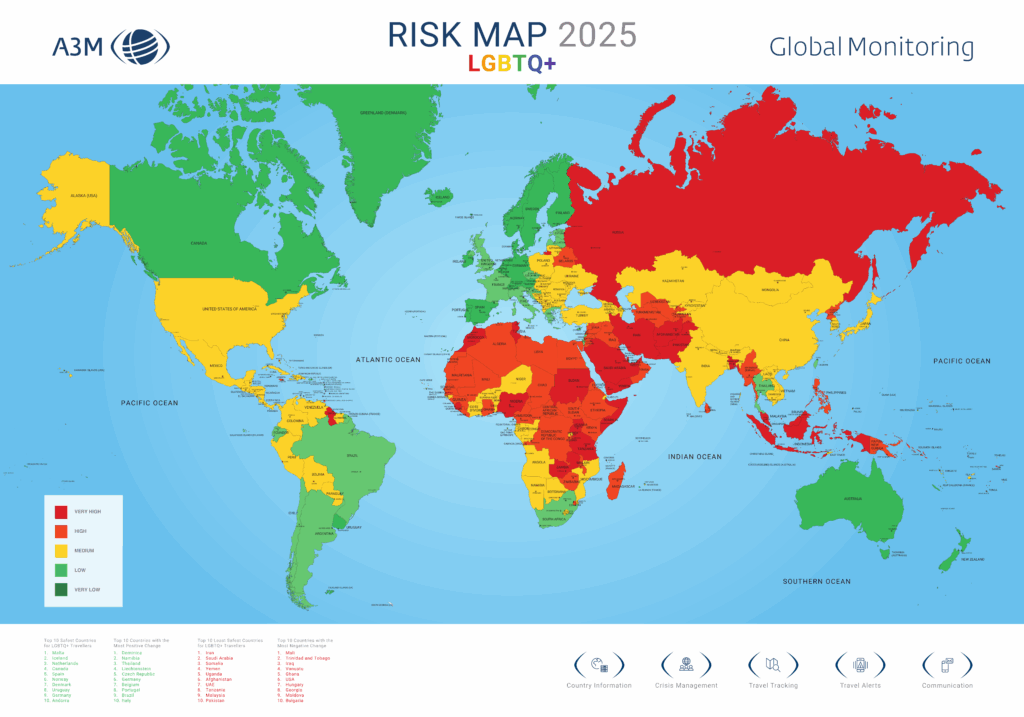
🌈 The A3M LGBTQ+ Risk Map 2025
As a company that assesses risks for leisure and business travellers, we provide country dossiers that assess the risk to travellers based on more than 80 risk criteria. In addition to our annual risk map, this year A3M Global Monitoring, in cooperation with Diversity Tourism and ITB Berlin, is publishing the LGBTQ+ Risk Map 2025, a world map to assess the safety for travellers from the LGBTQ+ community.
It focuses on the safest and least safe countries to travel to, exciting developments for LGBTQ+ travellers, as well as the results of surveys and interviews with travel experts and the experiences of travellers from the community.
Level 1
(dark green)
Akkordeon Inhalt
- Low risk; LGBTQ+ travellers rarely encounter issues
- Generally positive perceptions of LGBTQ+ individuals
Level 2
(light green)
Akkordeon Inhalt
- Legal, but societal perceptions are not always positive, especially outside of cities. Negative attitudes mostly affect the local population
- LGBTQ+ travellers rarely encounter issues
- PDA can lead to problems or unwanted attention
Level 3
(yellow)
Akkordeon Inhalt
- Legal, but discrimination present (e.g. same-sex marriages/partnerships not recognised, couples denied accommodation in hotels, difficulties accessing medical care, etc.)
- Structural homophobia/transphobia (e.g. discrimination when dealing with the police and authorities), including structural violence
- Prosecution based on moral laws / fines
Level 4
(red)
Akkordeon Inhalt
- Illegal
- wearing clothes that do not match the gender assigned at birth is criminalised/illegal
- LGBTQ+ travellers are at risk of persecution, arrest, and/or deportation
- Alternative gender markers on travel documents are illegal or not recognized
Level 5
(dark red)
Akkordeon Inhalt
- Illegal
- Sexual and gender minorities may face imprisonment (including life sentences), corporal punishment, and the death penalty
LGBTQ+ in the area of travel safety is a broad field, but we recognize the complexity of the topic:
Firstly, no country is homogenous and differences in attitudes towards LGBTQ+ vary in rural and urban areas.
Secondly, there can be significant differences between official policies, rules and regulations and the experiences of the community in their everyday lives.
There are countries that have extremely strict laws regarding homosexuality, but where there is a very active underground LGBTQ+ scene.
Thirdly, LGB is not the same as TQ+. While laws in unsafe countries often refer to homosexuality, issues such as gender, transition and non-binary gender identity are sometimes not even considered separately in legal terms, and the way they are dealt with varies according to country- and region-specific traditions.
Fourthly, the situation of holiday and/or business travellers can differ considerably from that of locals and immigrants.
Taking all these caveats into account, we have nevertheless decided to base our LGBTQ+ Risk Map 2025 largely on a legal perspective. In some cases, we were able to interview LGBTQ+ organizations and members of the community in order to take their lived experiences in the country into account; a detailed analysis of the survey can be found at the bottom of this page. The results are included in the colouring of the map and are formulated in places in our article below.
A3M Global Monitoring will continue to engage with stakeholders from various organizations to provide expertise from lived experience in future assessments.
Top 10 safest countries to travel to
for LGBTQ+ travellers
1. Malta
2. Iceland
3. Netherlands
4. Canada
5. Spain
6. Norway
7. Denmark
8. Uruguay
9. Germany
10 Andorra
Top 10 most unsafe countries to travel to
for LGBTQ+ travellers
1. Iran
2. Saudi Arabia
3. Somalia
4. Yemen
5. Uganda
6. Afghanistan
7 United Arab Emirates
8. Tanzania
9. Malaysia
10. Pakistan
Selection of safest countries for LGBTQ+ travellers 2024/2025
Iceland
Iceland is considered one of the safest countries for LGBTQ+ travellers due to its legal framework and acceptance in society. Conversion therapy has been completely banned since 2023, legal gender changes are made by self-ID, and same-sex marriages have been permitted since 2010. Police reports record hardly any hate crimes – even in rural areas. Reykjavík Pride (6-11 August 2025) and the colourful bar scene around Laugavegur create a visible, safe community.
Norway
Norway is once again in the world’s top 10 safest LGBTQ+ destinations in 2025. Same-sex couples can marry, adopt and even be wed in church; trans people have been able to easily change their gender by declaration since 2016. The government promotes Pride events nationwide, most notably Oslo Pride (20-28 June 2025) with over 150 events. City life is openly inclusive; hate crime is very rarely reported and if it is, it can be prosecuted consistently.
Malta
Malta leads the European Rainbow Map for the tenth time in a row in 2025, achieving 88.8 %. The island’s parliament enshrined registered partnerships in 2014, marriage in 2017, banned conversion therapy in 2016 and has allowed gender self-ID since 2015. New features include an LGBTQ+ community centre in Valletta and free HIV tests. Visible rainbow flags, little hate crime and largely inclusive hotels contribute to a holistically safer travelling experience.
Uruguay
Uruguay is considered South America’s LGBTQ+ pioneer: decriminalization since 1934, marriage and adoption since 2013 and 2009 respectively and a comprehensive trans law from 2018. The legal situation is therefore extremely liberal. Montevideo Pride fills Avenida 18 de Julio in September, and safe nightlife options also take place in beach towns such as Punta del Este. Trans people still occasionally report discrimination, but the police and ombudsman’s offices are reacting with increasing sensitivity. Overall, travellers can expect a safe and progressive environment.
Spain
Spain is one of the countries in the world with the most comprehensive LGBTQ rights. Same-sex marriages have been permitted since 2005, as has adoption. Transpersons have been able to change their gender from the age of 16 since 2023; conversion therapy is prohibited. Comprehensive anti-discrimination legislation also protects identity and expression in everyday life. Especially in cities such as Madrid, Barcelona and Valencia, the community is visible, safe and well-connected. In more rural regions, social acceptance can vary, but hate crime is prosecuted by the state. The combination of liberal legislation, social openness and state support makes Spain one of the safest and most inclusive LGBTQ+ destinations in Europe.
Selection of the most unsafe countries for LGBTQ+ travellers 2024/2025
Iran
Same-sex acts are still explicitly punishable in Iran – men face up to 100 lashes or the death penalty (§237 of the penal code, especially for “Livat”). Although trans people occasionally receive state-supported gender reassignment surgery, the attitude of large sections of society towards people from the LGBTQ+ community is predominantly negative, even hostile. Travellers are at the highest risk: even suspicion of homosexuality can result in immediate arrest, torture or even execution.
Saudi Arabia
In Saudi Arabia, any same-sex activity is prohibited under Sharia law – punishments range from imprisonment and lashes to the death penalty, and public symbols or online communication related to LGBTQ+ are also prosecuted. Travellers can be targeted by the CPVPV or the authorities simply by wearing rainbow symbols or making contact via digital media, which poses a constant threat. The security situation for the LGBTQ+ community is therefore extremely dangerous.
Somalia
Same-sex relationships are punishable throughout Somalia – in regions where Sharia law applies, this can be punished with death, elsewhere with prison sentences of up to three years according to national civil law. Even in regions where the rule of law is not fully present or cannot be enforced, people from the LGBTQ+ community are threatened with persecution by semi-state and social actors. There is a considerable risk for travellers, especially outside of diplomatically protected zones.
Yemen
In Yemen, same-sex acts are prohibited under state and Islamic law and can be punished with the death penalty. In the midst of the ongoing civil war, the violent situation is particularly threatening for LGBTQ+ people – state arbitrariness, militia pressure and public punishments are now documented. The country is absolutely unsuitable for travellers, as even the slightest hint of LGBTQ+ can be life-threatening.
Uganda
Since May 2023, the Anti-Homosexuality Act has banned homosexual acts and punished them with the death penalty; consensual partners face life imprisonment. “Propagating” LGBTQ+ can be punished with up to 20 years. The Constitutional Court confirmed these tougher penalties in April 2024, and arrests and violence continue to occur.
Developments in the year 2024/25
While LGBTQ+ rights in the safest countries for their members to travel have a history of fighting for recognition through legislation, other countries are in a process of transformation. In some cases, rights for members of the LGBTQ+ community are being restricted, in others laws are being enshrined that legally protect their communities and thus secure the basis for promoting visibility in public spaces, restricting hate crime or simply normalising LGBTQ+ as a whole.
Here we look at notable developments in legislation passed since April 2024 that are of interest to travellers in the LGBTQ+ community:
Top 10 countries with positive development
regarding LBGTQ+ legislation
1. Dominica
2. Namibia
3. Thailand
4 Liechtenstein
5. Czech Republic
6. Germany
7. Belgium
8. Portugal
9. Brazil
10. Italy
Top 10 countries with negative development
in terms of LGBTQ+ legislation
1. Mali
2. Trinidad and Tobago
3. Iraq
4 Vanuatu
5. Ghana
6. USA
7. Hungary
8. Georgia
9. Republic of Moldova
10. Bulgaria
Selection of countries with positive developments in terms of LBGTQ+ legislation
Dominica
Although there are few rights for LGBTQ+ people in Dominica in terms of protection against hate crime and equality, in April 2024 the Supreme Court repealed a law criminalising homosexuality that had been in place since 1873 after a complaint was filed that the law was incompatible with the constitution. There are no other restrictions for people in the LGBTQ+ community in Dominica, but there are also no protective laws.
Namibia
In Namibia, there are few legal protections for LGBTQ+ people, particularly in terms of anti-discrimination and protection from hate crime. Before and since the country’s independence in 1990, homosexual acts were considered criminal, but in June 2024, the High Court declared the criminalisation of same-sex acts between men unconstitutional and repealed the relevant laws. Namibia had already begun to recognise same-sex marriages concluded abroad in certain legal matters in 2023. While few restrictions and rights have been codified, social acceptance remains low and homophobic attacks occur in everyday life.
Thailand
The year 2025 began with a major change in the law in Thailand, the twelfth most visited tourist destination. While the law to legitimise same-sex marriage came into force on 23/01/2025, Thailand has a tradition of transsexuality, with gender reassignment surgery being performed since 1975. In addition to this now overdue legislation, homosexuality has been decriminalised since 1956 and there are also clubs in larger cities that specifically cater to the LGBTQ+ community. Outside of tourist centres and cities, however, discrimination and hostility can occur, as more conservative attitudes can prevail in rural Thailand.
Germany
Germany has a tradition of fighting for rights for the LGBT community, which is why homosexuality was decriminalised as early as 1968 in the GDR and 1969 in the FRG. Same-sex marriages have been permitted since 2017 and in November 2024 another important law came into force that further promotes inclusivity and gender self-determination. Since 2024, the Self-Determination Act has allowed transgender, non-binary and intersex people to change their legal first name and gender entry once a year through self-identification. In addition, “gender-specific” and “anti-sexual orientation” discrimination was included in the offence of hate crime in Berlin in 2023, which allows penalties based on more specific motives for offences and thus increases visibility and security. Although society in Germany is largely tolerant towards the LGBTQ+ community, cases of homophobia/trans-hostility still occur. There are legal safeguards against this.
Czech Republic
The Czech Republic also recorded a positive development in 2025. Same-sex marriages have been legal since 1962, and registered partnerships have been open to same-sex couples since 2006. Since January 2025, however, this has included almost all the rights of marriage, including stepchild adoption. Social acceptance has thus been further expanded, and a majority of the population is in favour of the complete opening up of marriage, even if this is still politically pending. Protection against discrimination is enshrined in law, although specific criminal law standards against hate crime are still lacking. Overall, developments show progress, even if there is still a need for action to protect against assaults.
Selection of countries with negative developments in terms of LBGTQ+ legislation
Mali
Mali is often found in the lower ranks of LGBTQ+ indices. This is due to a legal framework that was vaguely formulated until December 2024 and often interpreted as “immoral acts”. In December 2024, the military regime introduced a new penal code explicitly criminalising same-sex relationships between adults (§ 325-1 and § 325-2), a clear step towards a deterioration. At the same time, the constitution, which was amended in June 2023, enshrined marriage exclusively as a union between a man and a woman.
Trinidad and Tobago
In Trinidad and Tobago, LGBTQ+ people are not yet recognised or legally protected. A brief ray of hope made the headlines in April 2018 when the criminalisation of homosexual acts was repealed. However, the abolition of the Buggery Law was reversed by the Court of Appeal in March 2025 and same-sex acts between men were criminalised again, albeit with reduced maximum sentences of two to five years.
Iraq
Iraq is also consistently among the most dangerous countries for LGBTQ+ travellers. In April 2024, the parliament passed laws criminalising same-sex acts with up to 15 years in prison, “promotion” of homosexuality with at least seven years and public gender identity-related expressions. There is no protection against discrimination based on sexual orientation or identity. In addition, there is little acceptance in society for people from the LGBTQ+ community. There is state persecution by security forces, social stigmatisation and online platforms and dating apps are increasingly being used for targeted surveillance and blackmail.
Georgia
Homosexuality has been legal in Georgia since 2000 and a general anti-discrimination law has been in force since 2014, but in September 2024 the newly elected government of Georgia passed the law “For Family Values and Protection of Minors”, which prohibits same-sex marriage, adoption by LGBTQ+ couples, gender reassignment measures and public displays of LGBTQ+ relationships. The law also bans Pride events and rainbow flags and authorises the censorship of LGBTQ+ content in the media.
USA
With the start of Donald Trump’s second presidency, a clear trend towards restricting the rights of trans people can be observed in the USA. The official position of Trump’s government is the rejection of non-binary gender identities and transgender identity. This was expressed in January 2025 when Secretary of State Marco Rubio ordered that no new passports with the non-binary gender entry X may be issued. In June, this decision was then overturned by a court and the corresponding passports can be applied for again. However, the final decision is still pending. Transpersons are also to be excluded from serving in the armed forces. At state level, numerous states further expanded restrictions on gender reassignment treatment for minors and bans on LGBTQ content in schools, including Florida, Idaho, Indiana, Kansas, Kentucky, Louisiana, New Hampshire, Ohio, South Carolina, West Virginia and Wyoming. In Arizona, Arkansas, Florida, Iowa, Missouri, Oklahoma, Texas and West Virginia, non-binary gender entries in official documents have been made more difficult or banned. At the same time, liberal states are further strengthening civil rights and court decisions have blocked repressive laws in Kentucky, Massachusetts, Montana and Ohio, among others. The situation is highly polarised: While some regions offer security, others are experiencing a significant deterioration in the legal situation.